
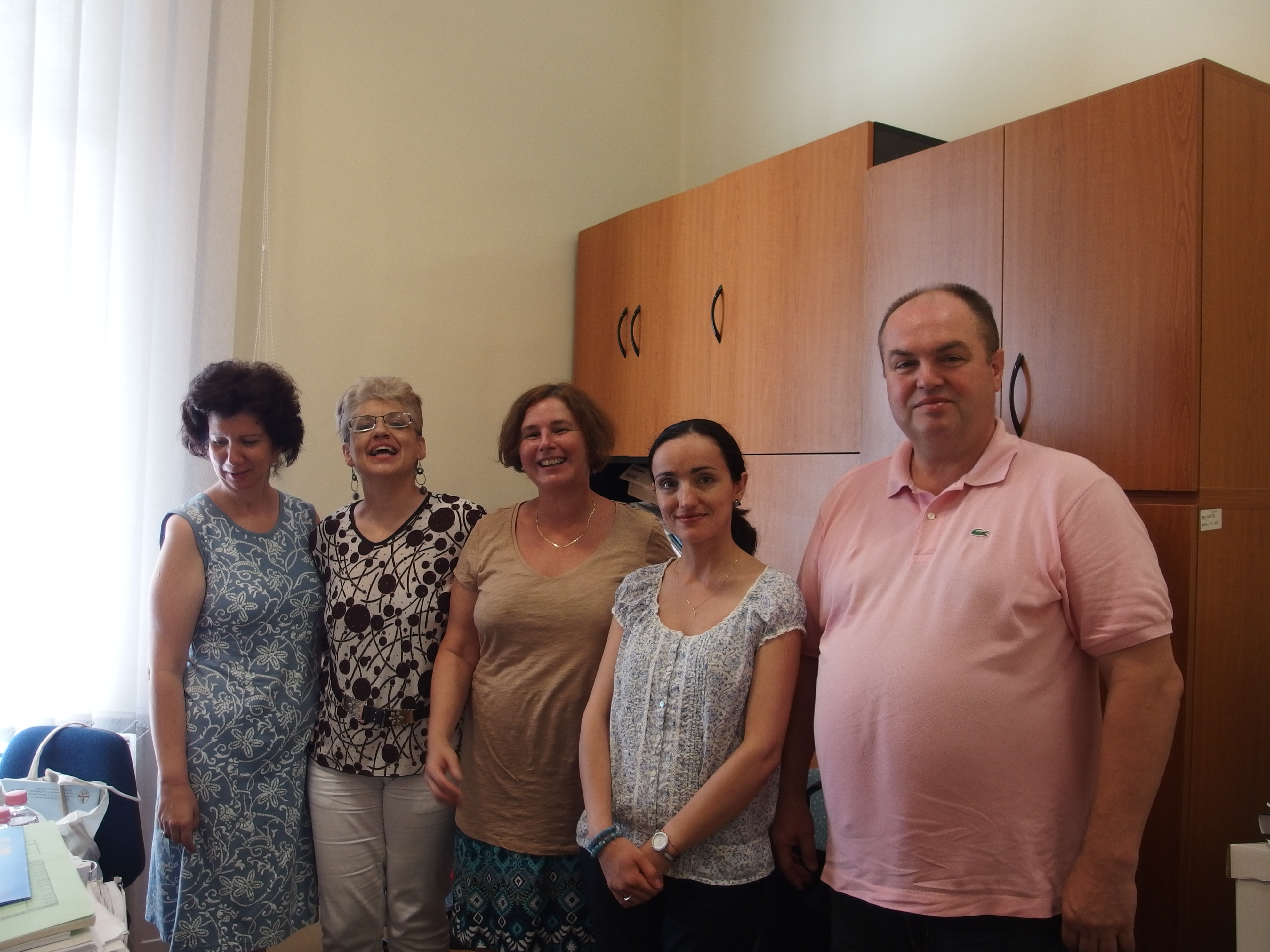

In the period from 6th to 10th of July 2015 under the project “New European Standards for the Implementation of Alternatives to Prison” was carried out a working visit to Budapest, Hungary, which aimed to explore the Hungarian experience in the implementation of adequate and actual alternatives to imprisonment. The working visit was a part of the activity “Research of European standards for probation and alternative measures - the experience of Norway and Hungary” project, financed by the Program BG15 of the Norwegian Financial Mechanism 2009- 2014 with Programme operator - Ministry of Justice.
In the study of the experience of Hungary participated research experts: Prof. Dr. Dobrinka Chankova, Dr. Elina Popova and Maya Mihaylova and project manager – Ivaylo Ivanov.
The program included meetings with leading Hungarian experts and professionals in the field of criminology, probation, restorative justice and mediation.
The expert team visited the National Institute of Criminology, where the team met with Dr. Tunde Barabas. Dr. Barabas presented the changes in Hungarian law committed in recent years in the field of divergent measures and the introduction of Victim – Offender Mediation. Presented were some practices that are currently piloted within projects. During the meeting Dr. Barabas provides materials and guidance documents to assist Bulgarian experts.
Interesting and very useful was the meeting that takes place within an external training for probation officers and prison officials for the implementation of restorative measures. This meeting was attended by Dr. Borbala Fellegi - researcher and Executive director of Foresee Research Group, Dr. Erika Magyar – coordinator of the Victim – Offender Mediators in the Probation Service of Hungary, Ms. Edit Velez – Advisor in the Department of Probation of the Office of Justice and Mrs. Vidia Negrea – Director for Central and Eastern Europe of International Institute of Restorative Practices.
The meeting allowed the Bulgarian experts to gain diverse and relevant information for the justice reform in Hungary, part of which are the alternatives to prison and implementation of pre-sentenced reports and reports on risk assessment. In Hungary mediation between victim and perpetrator is carried out of specially trained mediators within the probation service. Measures aimed at young offenders were also discussed with the Hungarian experts.
During the visit a meeting was held with Dr. Zsofia Yungbert – Legal advisor and expert in criminal law at the Prison in Vac. She was accompanied by Tamas Papai – a former prisoner, which is currently helping prisoners and prison staff as a volunteer and member of the Association for the protection and assistance of convicts. During the talks it was shared benefits of implementing restorative practices in prisons and the positive impact they have on inmates. Dr. Yungbert provides materials, photos and songs performed by prisoners.
Working visit to Hungary passed imperceptibly in friendly atmosphere and a lot of information was exchanged, as well as opportunities for future partnerships were outline. We express our thanks for the warm welcome and attention by our Hungarian colleagues.
The research of experience and documents will be presented in the report of the research experts, which will be ready in September 2015.